Good Dirt


We’ve all heard the phrase, “Wherever you go, there you are.”
It’s an important reminder that you can’t run from your problems if you are the problem. But I don’t think the phrase fully captures the value of running itself, or how it’s only through that running that you can unlock something within yourself.
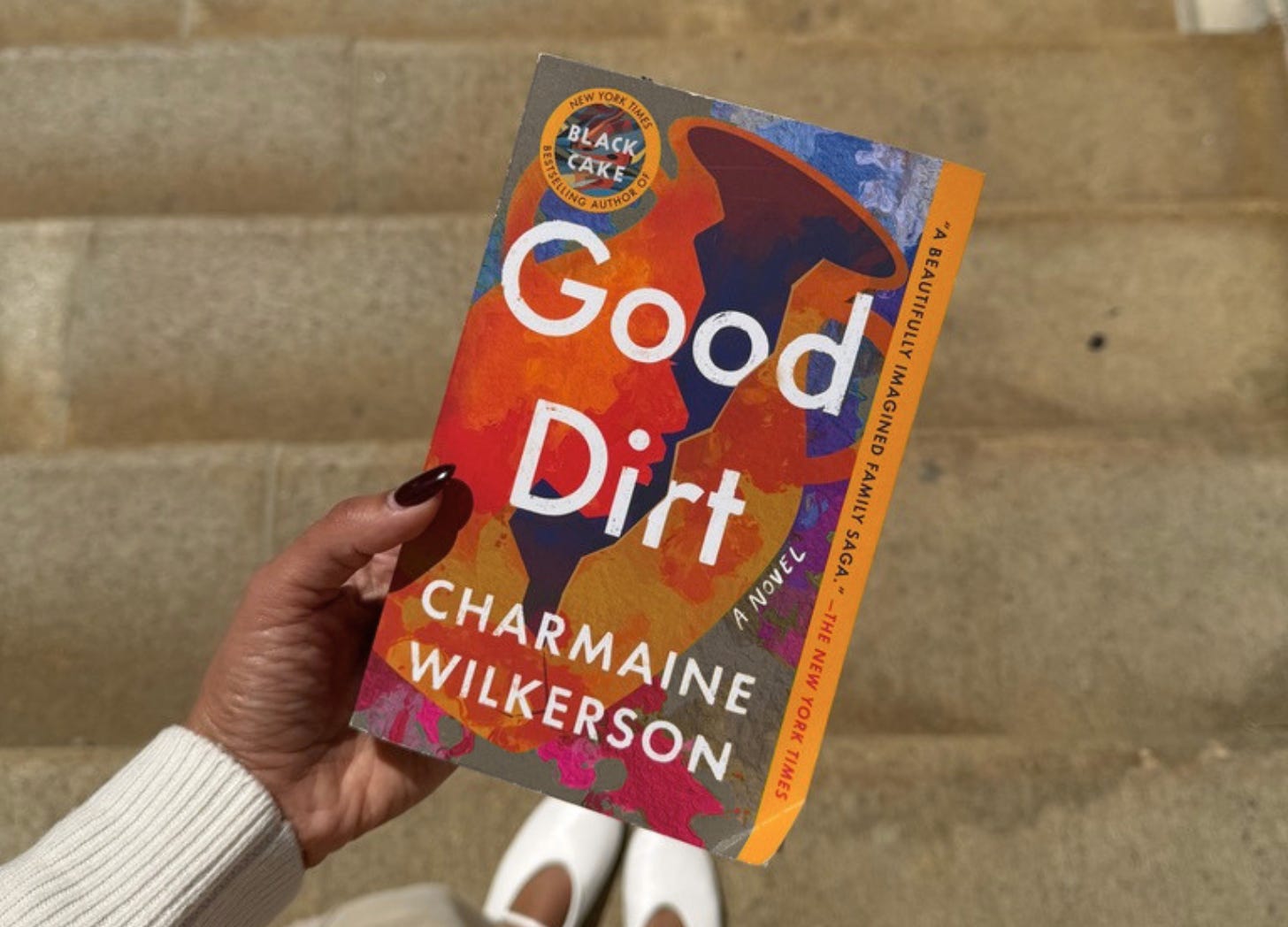
I started thinking about this while reading Good Dirt by Charmaine Wilkerson, Dwelle Literature’s April read.
The story follows Ebby Freeman, a 29-year-old upper-class Black woman whose life has been shaped by trauma. At only 10 years old, Ebby witnesses the murder of her older brother, Baz, during a home robbery gone wrong. Not only does Ebby watch her only sibling take his last breath, but the story spreads through their community like wildfire. Even a decade later, the story haunts her: she’s the Black girl whose brother was murdered, in every room she walks into.
Ebby thinks she’s finally found her happy ending, until her fiancé leaves her at the altar. The moment is soul-crushing and, given her ex’s family status, heavily publicized. Once again, Ebby’s name is spread through the town and tabloids. But this time, Ebby doesn’t push through it; she runs away.
A one-way ticket to Paris leaves Ebby at a charming cottage, completely distanced from her American life. When I learned that part of the plot took place in Paris, I was intrigued. A twenty-something-year-old moves abroad to find herself? Sign me up! I assumed Ebby would find a new job, a new passion, and ultimately a new man.
But the plot takes a sharp turn when her past catches up with her—literally. Only a few months into her stay, her ex, Henry, appears on her front doorstep with a new girlfriend in hand. It turns out that the Airbnb Henry booked for his bae-cation is connected to the same apartment where Ebby is living.
When I first read this twist, I found it corny. Of course, this forced proximity would send Ebby right back into Henry’s arms. But something far more interesting happens instead.
Through Henry’s point of view in the novel, we learn what Ebby’s perspective leaves out. We come to understand that Ebby has never truly processed watching her brother die. Her life is weighed down by terrible nightmares, paranoia, an aversion to risk, and a sensitivity to loud noises. Worst of all, when Henry would gently suggest her seeking treatment, she would lash out.
Henry did his best to love her through it all, but started to question how long he could walk on eggshells. As their wedding day approached, he began to doubt whether he could carry all this weight for the rest of his life. So, on the morning of their wedding, he ran away.
The way Henry left Ebby is inexcusable. But the novel made me sit with an uncomfortable question: is it valid to leave someone when you genuinely believe you can’t bear their pain?
Good Dirt adds another layer to this through the reality of Ebby and Henry's interracial relationship. Ebby's family is among the wealthiest and most prominent Black families on the East Coast, and she's nervous about the optics of being with a white man. In addition, Henry's family is not welcoming of a Black daughter-in-law or mixed grandchildren. They love each other, but love, Wilkerson suggests, isn't always enough to bridge the gap between two people's realities.
Towards the end of the novel, Ebby says, “Henry left me, in part, because he couldn’t handle all of who I was” (317). Opposites may attract, but that doesn’t mean they’ll last.
What I found compelling is that both Ebby and Henry ran away from their lives, and yet they still wound up face-to-face in Paris. Their instinct to flee didn’t take them as far as they hoped, but it did something more valuable: it prepared them to finally see themselves clearly.
By moving to Paris, Ebby realized, perhaps for the first time, that she had control over her own life, the power to start again, and the ability to define her own legacy. And with distance, Henry realized that Ebby deserved better than what he could give her.
I found a lot to love in this book, especially its unpredictability. I never quite knew what was coming next, and was pleasantly surprised by the twists and turns. I also don’t want to gloss over the novel’s historical fiction thread, which traces the significance of the Freeman Jar and why it suddenly becomes valuable in the 2000s. And of course, Ed and Soh’s story is powerful too, a portrait of how even a long, loving marriage contains its own moments of wanting to run.
I came to this book expecting a romance, and left it thinking about my own instincts to run away, and what I might find if I followed them. Maybe, “wherever you go, there you are” isn't a warning after all. Maybe it's a promise.