Open Water
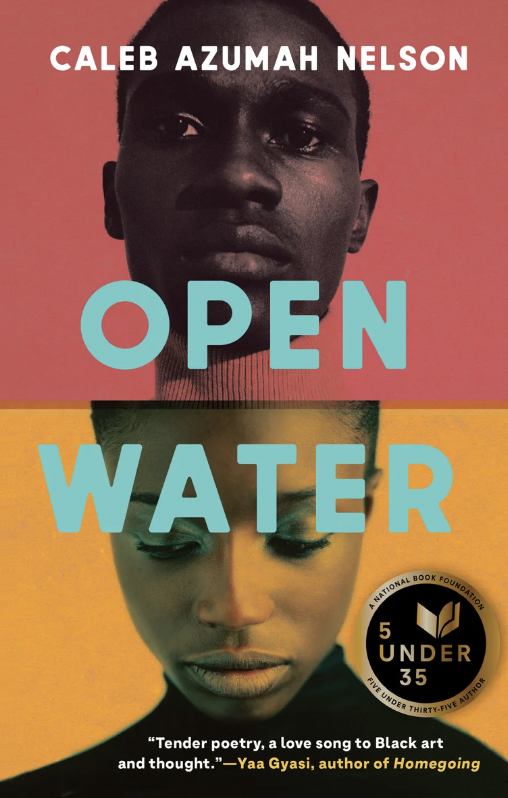

Open Water is a love story.
At its heart, it is a love story about two strangers who meet at a pub in London one night and experience what can only be described as love at first sight. Their relationship is complicated, messy, intense, and far from linear. But as we follow their story, it becomes clear that there are other forms of love present, forms that are just as important as romantic love.
Sound, Image, Inheritance
On the cover of my copy of Open Water is a quote from author Yaa Gyasi: “[Open Water is] tender poetry, a love song to Black art and thought.”
Gyasi’s description perfectly captures the novel because, embedded within the love between the two Black characters, is an equally profound love for music, art, literature, and film. I didn’t realize how many references to media appeared in the novel until I began writing them down. Nelson has quite literally provided us with a soundtrack for this story.
What makes these references compelling is that they never feel performative. The narrator’s music taste moves fluidly from Kendrick Lamar to A Tribe Called Quest to Playboi Carti. His film references include She’s Gotta Have It and Moonlight. For literature, he turns to James Baldwin and Zadie Smith, among others. This wide range of genres is precisely what makes the references feel authentic. There is no forced depth or manufactured profundity. Instead, reading these passages felt like watching a character think in real time. Nelson understands his narrator deeply and accurately reflects the shifting moods and inner life of someone in their twenties.
I laughed out loud at the novel’s mention of Playboi Carti and Saidiya Hartman within just a few pages of each other. When I was writing my dissertation in graduate school—a project that leaned heavily on Hartman’s work—I would sometimes take breaks by walking around the block, blasting Carti through my headphones. That juxtaposition felt familiar. It’s duality. It’s efficient. It’s human. It’s Black.
Of all the media referenced in the novel, the contemporary art resonated with me most. While music, film, and literature function almost as background noise, the visual art becomes a direct expression of the narrator’s interior life.
The first artwork mentioned is In the House of My Father by Donald Rodney. Rodney, a Black British artist, often used images from mass media to explore racial identity and racism. This piece, however, departs from his typical work. It is a photograph of Rodney’s hand holding a miniature house. What is not immediately visible is that the house is made from Rodney’s own skin, removed during surgery to treat sickle cell anaemia (Tate). Sickle cell is a debilitating inherited disease that disproportionately affects people of African and Caribbean descent and often carries a shortened life expectancy. Rodney dedicated the photograph to his father, who died while Rodney was hospitalized and unable to say goodbye.

In Open Water, the narrator reflects on this artwork, imagining himself holding the house of his father, his father’s father, and all those who came before him. He grapples with the weight of that inheritance, saying:
“Your first instinct is to ball your hand into a fist, crushing the thing, letting the weight drift to the ground; but perhaps it would be necessary to prise open its doors, to search the rooms which are lit, glance into those which are not, to see what, as of yet, remains unseen” (22)
This reference reveals more about the narrator than much of his dialogue ever could. It shows his intelligence, introspection, and cultural awareness. At the same time, it exposes his struggle to articulate vulnerability in his own words. He wants to show the woman he loves, rather than tell her directly, that his relationship with his father is complicated. By referring to this photograph, he can more effectively communicate that he is unsure whether his relationship with his father is something to hold carefully or destroy entirely.
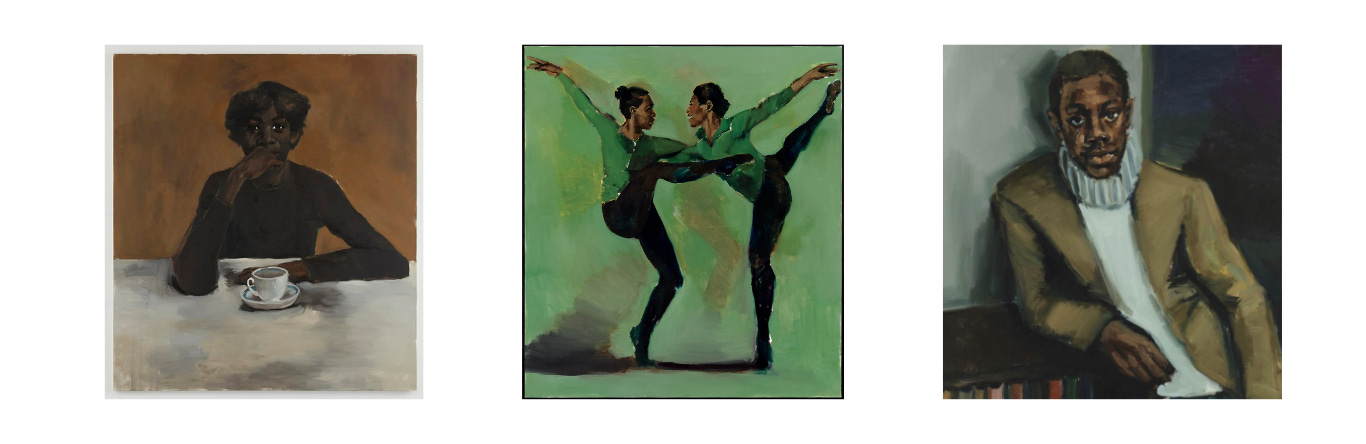
One line that repeats throughout the novel is “language fails us” (22). This idea helps explain the narrator’s reliance on music, film, and art. Later in the novel, the narrator cites British-Ghanaian painter Lynette Yiadom-Boakye as one of his greatest influences. Yiadom-Boakye is known for painting imagined Black figures; people who exist only in her mind. He observes that “by doing this, she’s externalizing her interiority, which isn’t something Black people are afforded very often” (99).
I paused after reading that line. This explanation of Black art as an act of freedom, of expression as liberation, is essential. To dream freely is a luxury. To bring what lives inside you to the surface is an act of defiance. The narrator of Open Water understands this deeply, and yet, he is unable to do it himself. He knows the value of expression. He admires those who practice it. So why can’t he take that next step?
Masculinity, Vulnerability, and Brotherhood
Another essential form of love in the novel is the narrator’s relationship with his brother. Their bond is strained; he feels more like a father and protector than an older sibling. That imbalance breeds anger and resentment. And yet, as with many sibling relationships, beneath that tension lies an untouchable, enduring love.
Nelson’s use of language is deliberate, and one word that recurs meaningfully is “held.” The narrator struggles with vulnerability; he is traumatized by his encounters with the police and lives with constant anxiety and paranoia. He carries this pain alone, releasing it only in private. When reflecting on his inability to be emotionally open with the woman he loves, he admits:
“You want to believe that her comfort can alleviate the situation, but only if you allow yourself to be held” (119)
To be held is to be vulnerable. It means allowing someone to carry the parts of you that feel too heavy to bear alone. As much as the narrator longs for that intimacy with his partner, he cannot give it to her. But he can give it to his brother.
After the breakup, he withdraws completely, afraid, even, of the sun. The only person who checks in on him is his brother. In one scene, the brother sits on the edge of the bed and asks, “How are you feeling?” It is here that the narrator finally breaks. Few words are exchanged, but it is the most vulnerable moment we see him share with another person:
“You allow yourself to be held, as you have done for him before. You allow yourself to be soft and child-like in his arms. You allow yourself to break” (138)
This passage devastated me, but it is also deeply beautiful. While it is painful to witness his emotional distance from the woman he loves, it is moving to see him fully himself with his brother. Without stating it outright, the novel captures the irreplaceable value of siblings: they are the ones who remain, ready to hold you when everything else falls apart.

Open Water
Finally, there is the love that kept me turning the pages: romantic love. I have always been drawn to the idea of instant connection, to the concept of soulmates. To know before you know that you have found the right person feels like the purest definition of romance.
“You feel you have never been strangers. You do not want to leave each other, because to leave is to have the thing die in its current form and there is something, something in this that neither is willing to relinquish” (17)
The novel overflows with poetic declarations like this, and yet it ends with the two lovers apart. Open Water is not a story about the man who gets the girl, but about the man who does not know what to do once he has her. As a woman reading this, I wanted to scream: just tell her how you feel. But the truth is, he can’t.
So where do we go from here?
“It’s easier to hide in your own darkness, than to emerge, naked and vulnerable, blinking in your own light. Even here, in plain sight, you’re hiding” (140)
The first time I read Open Water, I thought the ending was tragic. Why don’t we get the happy ending? But a second read this month led me to a different, more optimistic conclusion.
Open Water is a meditation on the reality that love, on its own, is not enough. Fear, anxiety, resentment, and guilt are all emotions that can send us running from the one we love. These emotions make the narrator choose distance over intimacy and silence over honesty.
And yet, the novel ends with the promise of possibility. We get a glimpse of him trying to be better for himself, and in turn, better for her. Although the novel has ended, their story is only just beginning.
Although we may have expected the two to learn to swim side by side, what becomes more important is that he is learning to swim by himself, in open water.